Categories

Apostolado da Oração

Search

The Inception Point: Schelling’s Construction of the ‘System of Times
The Inception Point: Schelling’s Construction of the ‘System of Times
Max K. Feenan, “The Inception Point: Schelling’s Construction of the ‘System of Times,’” Revista Portuguesa de Filosofia 82, nos. 1–2 (2026): 111–28, https://doi.org/10.17990/RPF/2026_82_1_0111.

More details

On sale On sale!
10,00 € tax excl.

218210111

Online only


  • The Inception Point: Schelling’s Construction of the ‘System of Times’

    Item Type Journal Article
    Author Max K. Feenan
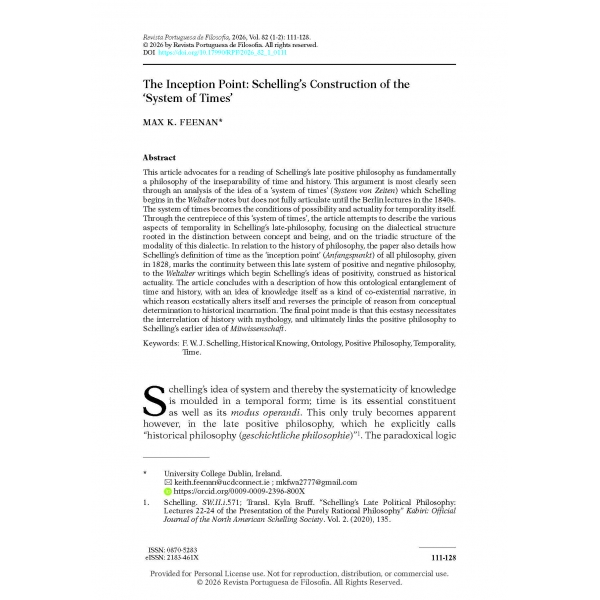
    Abstract This article advocates for a reading of Schelling’s late positive philosophy as fundamentally a philosophy of the inseparability of time and history. This argument is most clearly seen through an analysis of the idea of a ‘system of times’ (System von Zeiten) which Schelling begins in the Weltalter notes but does not fully articulate until the Berlin lectures in the 1840s. The system of times becomes the conditions of possibility and actuality for temporality itself. Through the centrepiece of this ‘system of times’, the article attempts to describe the various aspects of temporality in Schelling’s late-philosophy, focusing on the dialectical structure rooted in the distinction between concept and being, and on the triadic structure of the modality of this dialectic. In relation to the history of philosophy, the paper also details how Schelling’s definition of time as the ‘inception point’ (Anfangspunkt) of all philosophy, given in 1828, marks the continuity between this late system of positive and negative philosophy, to the Weltalter writings which begin Schelling’s ideas of positivity, construed as historical actuality. The article concludes with a description of how this ontological entanglement of time and history, with an idea of knowledge itself as a kind of co-existential narrative, in which reason ecstatically alters itself and reverses the principle of reason from conceptual determination to historical incarnation. The final point made is that this ecstasy necessitates the interrelation of history with mythology, and ultimately links the positive philosophy to Schelling’s earlier idea of Mitwissenschaft.
    Date 2026
    Language English
    Library Catalog 193; 113; 115; 126; 210
    License © 2026 by Aletheia - Associação Científica e Cultural
    Volume 82
    Place Braga
    Publisher Axioma - Publicações da Faculdade de Filosofia
    Section Schelling’s Legacy in Contemporary Philosophy. Celebrating the 250th Anniversary of Schelling’s Birth
    Pages 111-128
    Publication Revista Portuguesa de Filosofia
    DOI 10.17990/RPF/2026_82_1_0111
    Issue 1-2
    Journal Abbr RPF
    ISSN 0870-5283 ; 2183-461X
    Date Added 7/31/2026, 8:54:17 PM
    Modified 8/1/2026, 1:13:35 PM

    Tags:

    • Ontology
    • Time
    • F. W. J. Schelling
    • Historical Knowing
    • Positive Philosophy
    • Temporality

    Notes:

    • {SW} Schelling. Hg. K. F. A. Schelling. Sämmtliche Werke. 2 Abt. Vols. 10/4 Bde. Stuttgart: Cotta’sche Verlagsbuchhandlung, 1856–61.

      {HKA} Schelling. Hrsg. Bayerischen Akademie der Wissenschaften. 3 Abt. Historisch-kritische Ausgabe. Stuttgart: Frommann-Holzboog, 1976-.

      {GW} Hegel. Hrsg. Rheinisch-Westfälischen Akademie der Wissenschaften. 31 Bde. Gesammelte Werke. Hamburg: Felix Meiner Verlag, 1968.

      Bell, John Stewart. Collected Papers on Quantum Philosophy: Speakable and Unspeakable in Quantum Mechanics. Cambridge: Cambridge University Press, 1987.

      Bruff, Kyla. “Schelling’s Late Political Philosophy: Lectures 22-24 of the Presentation of the Purely Rational Philosophy” Kabiri: Official Journal of the North American Schelling Society. Vol. 2. (2020): 93-135.

      Bubner, Rüdiger. Ed. German Idealist Philosophy. Harmondsworth: Penguin Books, 1997[1978].

      Fakhoury, Hadi. “F.W.J. Schelling’s Monument to Jacobi’s Work on the Divine Things (1812) (excerpts)” Kabiri: Official Journal of the North American Schelling Society. Vol. 4. (2024): 162-198.

      Franks, Paul. “Peirce’s Schelling-Fashioned Idealism and the Monstrous Mysticism of the East.” British Journal for the History of Philosophy. 23, no. 4. (2015): 732-755.

      Fuhrmans, Horst and Liselotte Lohrer. Eds. Schelling und Cotta: Briefwechsel, 1803-1849. Stuttgart: Ernst Klett Verlag, 1965.

      Gulyga, Arsenij. transl. Elke Kirsten. Schelling: Leben und Werk. Stuttgart: Deutsche Verlags-Anstalt, 1989[1982].

      McGrath and Joseph Carew. Eds. Rethinking German Idealism. London: Palgrave Macmillan, 2016.

      McGrath, Sean J. The Philosophical Foundations of the Late Schelling: The Turn to the Positive. (Edinburgh: Edinburgh University Press, 2023[2021])

      Schelling. eds. Alexander Bilda, Jason Wirth & David Farrell Krell. On the Deities of Samothrace. Bloomington & Indianapolis IN: Indiana University Press, 2025.

      Schelling. eds. Judith Norman and Slavoj Zizek. The Abyss of Freedom/Ages of the World. Ann Arbor MI: University of Michigan Press, 1997.

      Schelling. hg. Horst Fuhrmans. Initia Philosophiae Universae: Erlanger Vorlesung WS 1820/21. Bonn: Bouvier & Co., 1969.

      Schelling. hg. Manfred Frank. Philosophie der Offenbarung, 1841/42. Frankfurt am Main: Suhrkamp Verlag, 2016[1977].

      Schelling. hg. Manfred Schröter. Die Weltalter. Fragmente. In den Urfassungen von 1811 und 1813. Munich: C. H. Beck’sche Verlagsbuchhandlung, 1993[1946].

      Schelling. hg. Siegbert Peetz. System der Weltalter: Münchener Vorlesung 1827/28 in einer Nachschrift von Ernst von Lasaulx. Frankfurt am Main: Vittorio Klostermann, 1998[1990].

      Schelling. hg. Walter E. Ehrhardt. Urfassung der Philosophie der Offenbarung. (Hamburg: Felix Meiner Verlag, 1992.

      Schelling. hrsg. Klaus Vieweg, Christian Danz, & Georgia Apostolopoulou. Philosophie der Mythologie in drei Vorlesungsnachschrift, 1837/42. München & Paderborn: Wilhelm Fink, 1996.

      Schelling. hrsg. Lothar Knatz, Hans-Jörg Sandkühler & Martin Schraven. Philosophische Entwürfe und Tagebücher Band 1, 1809-1813: Philosophie der Freiheit und der Weltalter. Hamburg: Felix Meiner, 1994.

      Schelling. transl. Bruce Matthews. The Grounding of the Positive Philosophy: The Berlin Lectures. Albany NY: State University of New York Press, 2007.

      Schelling. transl. E. S. Morgan and Norbert Guterman. On University Studies. Athens OH: Ohio University Press, 1966.

      Schelling. transl. Jason M. Wirth. The Ages of the World. (Fragment) from the handwritten remains Third Version (c. 1815). Albany NY: State University of New York Press, 2000.

      Schelling. transl. Jeff Love & Johannes Schmidt. Philosophical Investigations into the Essence of Human Freedom. Albany NY: State University of New York Press, 2006.

      Schelling. transl. Joseph Lawrence. The Ages of the World Book One: The Past (Original Version, 1811). (Albany NY: State University of New York Press, 2019.

      Schelling. transl. Klaus Ottmann. Philosophy of Revelation (1841-42) and Other Related Texts. Thomson CT: Spring Publications, 2020.

      Schelling. transl. Mason Richey & Markus Zisselsberger. Historical-Critical Introduction to the Philosophy of Mythology. Albany NY: State University of New York Press, 2007.

      Skrupskelis, Ignas and Elizabeth Berkeley. Eds. The Correspondence of William James. 12 Vols. Charlottesville: University of Virginia Press, 1992–2004. 

Search

Cart  

No products

Shipping 0,00 €
Total 0,00 €

Cart Check out

PayPal