Categorias

Produtos vistos

Apostolado da Oração

Pesquisa

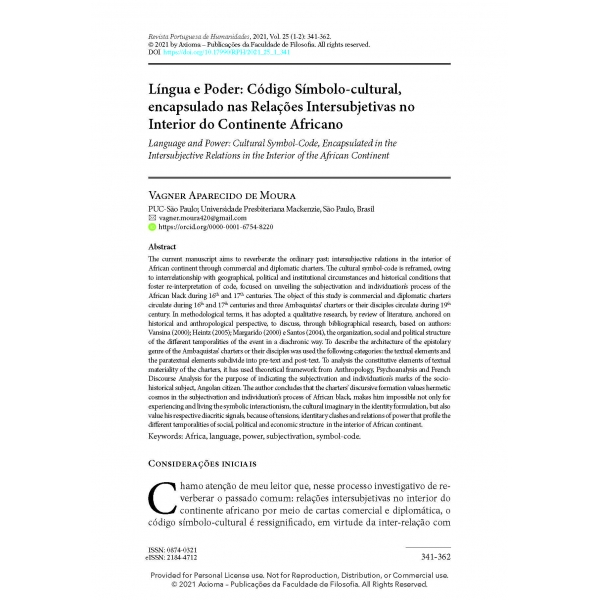
Língua e Poder: Código Símbolo-cultural, encapsulado nas Relações Intersubjetivas no Interior do Continente Africano

Língua e Poder: Código Símbolo-cultural, encapsulado nas Relações Intersubjetivas no Interior do Continente Africano

Vagner Aparecido de Moura, “Língua e Poder: Código Símbolo-cultural, encapsulado nas Relações Intersubjetivas no Interior do Continente Africano,” Revista Portuguesa de Humanidades 25, no. 1–2 (2021): 341–62, https://doi.org/10.17990/RPH/2021_25_1_341.

Mais detalhes

À venda À venda!
10,00 €

232510341


  • Língua e Poder: Código Símbolo-cultural, encapsulado nas Relações Intersubjetivas no Interior do Continente Africano

    Type Journal Article
    Author Vagner Aparecido de Moura
    Rights © 2021 Aletheia - Associação Científica e Cultural
    Volume 25
    Issue 1-2
    Pages 341-362
    Publication Revista Portuguesa de Humanidades
    ISSN 0874-0321
    Date 2021
    Extra Language and Power: Cultural Symbol-Code, Encapsulated in the Intersubjective Relations in the Interior of the African Continent
    DOI 10.17990/RPH/2021_25_1_341
    Language Portuguese
    Abstract The current manuscript aims to reverberate the ordinary past: intersubjective relations in the interior of African continent through commercial and diplomatic charters. The cultural symbol-code is reframed, owing to interrelationship with geographical, political and institutional circumstances and historical conditions that foster re-interpretation of code, focused on unveiling the subjectivation and individuation’s process of the African black during 16th and 17th centuries. The object of this study is commercial and diplomatic charters circulate during 16th and 17th centuries and three Ambaquistas’ charters or their disciples circulate during 19th century. In methodological terms, it has adopted a qualitative research, by review of literature, anchored on historical and anthropological perspective, to discuss, through bibliographical research, based on authors: Vansina (2000); Heintz (2005); Margarido (2000) e Santos (2004), the organization, social and political structure of the different temporalities of the event in a diachronic way. To describe the architecture of the epistolary genre of the Ambaquistas’ charters or their disciples was used the following categories: the textual elements and the paratextual elements subdivide into pre-text and post-text. To analysis the constitutive elements of textual materiality of the charters, it has used theoretical framework from Anthropology, Psychoanalysis and French Discourse Analysis for the purpose of indicating the subjectivation and individuation’s marks of the socio-historical subject, Angolan citizen. The author concludes that the charters’ discursive formation values hermetic cosmos in the subjectivation and individuation’s process of African black, makes him impossible not only for experiencing and living the symbolic interactionism, the cultural imaginary in the identity formulation, but also value his respective diacritic signals, because of tensions, identitary clashes and relations of power that profile the different temporalities of social, political and economic structure in the interior of African continent.
    Date Added 1/20/2022, 3:07:09 PM
    Modified 1/20/2022, 3:37:40 PM

    Tags:

    • Africa, language, power, subjectivation, symbol-code

    Notes:

    • Candau, Joel. Memória e identidade. São Paulo: Contexto, 2011.
      Dias, Jill, “ Angola”, em O império Africano 1825-1890, ed Valentin, Alexandre e Dias, Jill, Lisboa, Editorial Estampa.
      Fonseca, Maria Bracks e Souza, Maria de Mello, “ Nzinga Mbandi contra os portugueses em Angola Século XVII” em Anais do XXVI Simpósio Nacional de História – ANPUH. São Paulo, julho 2011.
      Foucault, Michel. Arqueologia do Saber. Rio de Janeiro: Forense Universitária, 1986
      Gonçalves, José Reginaldo Santos, “ Os limites do patrimônio”, em Antropologia e patrimônio cultural. Diálogos e desafios contemporâneos, ed Lima Filho, Manuel Ferreira, Eckert, Cornelia, Beltrão, Jane Felipe, Blumenau: Nova Letra/ABA, 2007
      Heintze, Beatrix, “ A lusofonia no interior da África Central na era pré-colonial: Um contributo para a sua história e compreensão na actualidade”, Cadernos de Estudos Africanos, 7. n. 5 (2005): 179-207, doi.org/10.4000/cea.1361
      Heintze, Beatrix, Fontes para a história de Angola do século XVII. I. Memórias, relações e outros manuscritos da Colectânea Documental de Fernão de Souza (1622-1635). Stuttgart, 1985.
      Heintze, Beatrix, Fontes para a história de Angola do século XVII. II. Cartas e documentos oficiais da Colectânea Documental de Fernão de Souza (1624-1635). Stuttgart, 1988.
      Jung, Carl Gustav. Psicologia do inconsciente. Petrópolis, Vozes, 1978ª.
      Jung, Carl Gustav. Eu e o inconsciente. Petrópolis, Vozes, 1978b.
      Jung, Carl Gustav. Aion – Estudo sobre o simbolismo do si mesmo. Petrópolis, Vozes, 1982.
      Leonard, Yves, “As ligações a África e ao Brasil”em História da expansão portuguesa ed Bethencourt, Francisco e Chaudhiri, Kirty (Orgs), V, Lisboa: Círculo de Leitores (1998) 421-441.
      Lourenço, Eduardo, A Nau de Ícaro seguido de Imagem e Miragem da Lusofonia. Lisboa: Edições Grádiva (2004).
      Margarido, Alfredo. A lusofonia e os lusófonos: Novos mitos portugueses. Lisboa: Edições Universitárias Lusófonas. 2000.
      Muxel, Anne. Individu et memoire familiale. Paris: Nathan, 1996.
      Rotman, Monica e Castells, Alicia, “ Patrimônio e cultura: processos de politização, mercantilização e construção de identidades”, em Antropologia e patrimônio cultural. Diálogos e desafios contemporâneos, ed Lima Filho, Manuel e Eckert, Cornelia e Beltrão Jane, Blumenau: Nova Letra/ABA, 2007.
      Santos, Catarina Madeira, “ Escrever o poder. Os autos de vassalagem e a vulgarização da escrita entre os africanos: o caso dos Ndembu em Angola (séculos XVII-XX) “, em Angola on the Move: Transport Routes, Communications and History, eds Heintz, Beatrix e Oppen, Achim Von, consultado em 27 de agosto de 2017, http: www.zmo.de/angola
      Serrão, Joel. Dicionário de História de Portugal (4 vols). Lisboa: iniciativas Editoriais, 1971. Vol.III, 474-475.
      Sodré, Muniz. Claros e escuros: identidade, povo e mídia no Brasil. Petrópolis, RJ: Vozes, 1999.
      Todorov, Tzevtan. Os gêneros do discurso. Trad. Christina Cabo. São Paulo: Martins Fontes, 2003.
      Vansina, Jan “ Portuguese vs Kimbundu: Language Use in the Colony of Angola (1575 – c. 1845)”, Bulletin des Séances de l’Academie royale des Sciences d’Outre-Mer, vol.47, (3), 267-281, (2001).
      Vansina, Jan e T. OBENGA “ Le Royaume de Kongo et ses voisins” em L’ Afrique du XVI au XVIII e siècle, ed Directeur Professeur B.A. Ogot. Edition abrégée. Paris. UNESCO. (1998)
      Vansina, Jan, « More on the invasion of Kongo and Angola by the Jaga and the Lunda», Journal of African History, Londres, VII (3), 1966.
      Zanotto, Normelio. E-mail e carta comercial: estudo constrastivo de gênero textual. Rio de Janeiro: Lucerna; Caxias do Sul: Educs, 2005.

Pesquisa

Carrinho  

Sem produtos

Envio 0,00 €
Total 0,00 €

Carrinho Encomendar

PayPal