Fabricating the Truth About Bruno Latour(s)
David Inglis and Anna-Mari Almila, “Fabricating the Truth About Bruno Latour(s),” Revista Portuguesa de Filosofia 79, no. 3 (2023): 1143–62, https://doi.org/10.17990/RPF/2023_79_3_1143.


Andreia Barbosa e Ângela Azevedo,...

Ricardo Barroso Batista, “Book Review -...

David Inglis and Anna-Mari Almila, “Fabricating the Truth About Bruno Latour(s),” Revista Portuguesa de Filosofia 79, no. 3 (2023): 1143–62, https://doi.org/10.17990/RPF/2023_79_3_1143.
| Item Type | Journal Article |
|---|---|
| Author | David Inglis |
| Author | Anna-Mari Almila |
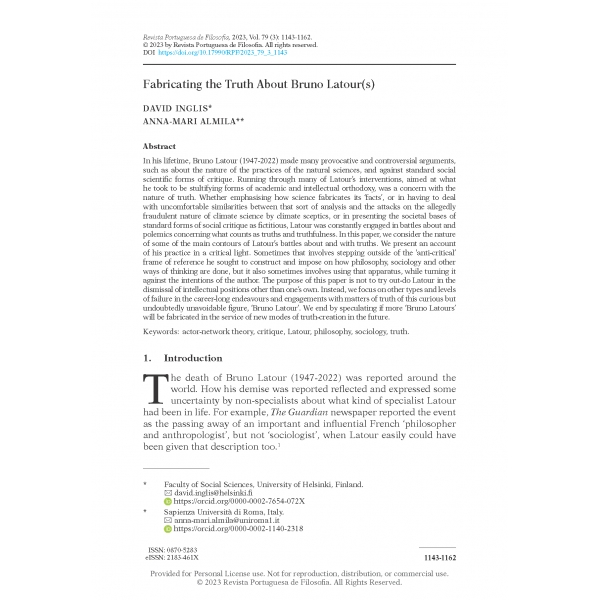
| Abstract | In his lifetime, Bruno Latour (1947-2022) made many provocative and controversial arguments, such as about the nature of the practices of the natural sciences, and against standard social scientific forms of critique. Running through many of Latour’s interventions, aimed at what he took to be stultifying forms of academic and intellectual orthodoxy, was a concern with the nature of truth. Whether emphasising how science fabricates its ‘facts’, or in having to deal with uncomfortable similarities between that sort of analysis and the attacks on the allegedly fraudulent nature of climate science by climate sceptics, or in presenting the societal bases of standard forms of social critique as fictitious, Latour was constantly engaged in battles about and polemics concerning what counts as truths and truthfulness. In this paper, we consider the nature of some of the main contours of Latour’s battles about and with truths. We present an account of his practice in a critical light. Sometimes that involves stepping outside of the ‘anti-critical’ frame of reference he sought to construct and impose on how philosophy, sociology and other ways of thinking are done, but it also sometimes involves using that apparatus, while turning it against the intentions of the author. The purpose of this paper is not to try out-do Latour in the dismissal of intellectual positions other than one’s own. Instead, we focus on other types and levels of failure in the career-long endeavours and engagements with matters of truth of this curious but undoubtedly unavoidable figure, ‘Bruno Latour’. We end by speculating if more ‘Bruno Latours’ will be fabricated in the service of new modes of truth-creation in the future. |
| Date | 2023 |
| Language | English |
| Rights | © 2023 Aletheia - Associação Científica e Cultural |
| Volume | 79 |
| Pages | 1143-1162 |
| Publication | Revista Portuguesa de Filosofia |
| DOI | 10.17990/RPF/2023_79_3_1143 |
| Issue | 3 |
| ISSN | 0870-5283 ; 2183-461X |
| Date Added | 11/1/2023, 1:42:26 AM |
| Modified | 11/1/2023, 2:00:11 AM |
Agathangelou, Anna M. “Bruno Latour and Ecology Politics: Poetics of Failure and Denial in IR.” Millennium 44 no. 3 (2016): 321–347. https://doi.org/10.1177/030582981664.
Amsterdamska, Olga. “Surely You Are Joking, Monsieur Latour!.” Science, Technology and Human Values 15 no. 4 (1990): 495–504. https://doi.org/10.1177/01622439900150.
Anderson, Warwick. “Introduction: Postcolonial Technoscience,” Social Studies of Science 32 no. 5/6 (2011): 643-658. https://doi.org/10.1177/030631270203200502.
Bloor, David. “Anti-Latour.” Studies in the History and Philosophy of Science 30 no. 1 (1999): 81–112. https://doi.org/10.1016/s0039-3681(98)00038-7.
Bourdieu, Pierre. Pascalian Meditations. Cambridge: Polity, 2000.
Brown, Mark B. “Speaking for Nature: Hobbes, Latour, and the Democratic Representation of Nonhumans.” Science and Technology Studies 31 no. 1 (2018): 31–51. https://doi.org/10.23987/sts.60525.
Burns, Lorna. “World Literature and the Problem of Postcolonialism: Aesthetics and Dissent,” In The Work of World Literature, edited by Francesco Giusti and Benjamin Lewis Robinson, 57-74. Berlin: ICI Berlin Press, 2021. https://doi.org/10.37050/ci-19_03.
Callon, Michel, and Bruno Latour. “Unscrewing the Big Leviathan: How Actors Macro – Structure Reality and How Sociologists Help Them Do So?.” In Advances in Social Theory and Methodology, edited by Karin Knorr Cetina and Aaron Cicourel, 277-303. London: Routledge and Kegan Paul, 1981.
Chakrabarty, Dipesh. “Planetary Humanities: Straddling the Decolonial/Postcolonial Divide,” Daedalus 151 no. 3 (2022): 222–233. https://doi.org/10.1162/daed_a_01940.
Flatscher, Matthias, and Sergej Seitz. “Latour, Foucault, and Post-Truth.” Genealogy and Critique 6 no. 1 (2020): 1–23. https://doi.org/10.16995/lefou.83.
Giraud, Eva, and Sarah-Nicole Aghassi-Isfahani. “Post-Truths, Common Worlds, and Critical Politics: Critiquing Bruno Latour’s Renewed Critique of Critique.” Cultural Politics 16 no. 1 (2020): 1–13. https://doi.org/10.1215/17432197-8017200.
Halberstam, Jack. The Queer Art of Failure. Durham: Duke University Press, 2011.
Harman, Graham. Prince of Networks: Bruno Latour and Metaphysics. Melbourne: re.press, 2009.
Harman, Graham. Bruno Latour: Reassembling the Political. London: Pluto Press, 2014.
Heinich, Nathalie. “Une Sociologie Très Catholique? À Propos de Bruno Latour.” Esprit 334 no. 5 (2007), 14–26. https://doi.org/10.3917/espri.0705.0014.
Hennion, Antoine. “From ANT to Pragmatism: A Journey with Bruno Latour at the CSI.” New Literary History 47 no. 2/3 (2016): 289–308. https://www.proquest.com/scholarly-journals/ant-pragmatism-journey-with-bruno-latour-at-csi/docview/1829708546/se-2.
Johnson, Jim. “Mixing Humans and Nonhumans Together: The Sociology of a Door-Closer.” Social Problems 35 no. 3 (1988): 298–310. https://doi.org/10.2307/800624.
Knight, Lucy and Angelique Chrisafis “Bruno Latour, French Philosopher and Anthropologist, Dies Age 75.” The Guardian, 9th October (2022), https://www.theguardian.com/world/2022/oct/09/bruno-latour-french-philosopher – anthropologist-dies.
Korom, Philipp. “The Prestige Elite in Sociology.” The Sociological Quarterly 61 no.1 (2020): 128–163. https://doi.org/10.1080/00380253.2019.1581037.
Krarup, Troels Magelund, and Anders Blok. “Unfolding the Social: Quasi-Actants, Virtual Theory, and the New Empiricism of Bruno Latour.” The Sociological Review 59 no. 1 (2011): 42–63. https://doi.org/10.1111/j.1467-954X.2010.01991.x.
Latour, Bruno. Science in Action. Cambridge, Mass: Harvard University Press, 1987.
Latour, Bruno. The Pasteurization of France. Cambridge, Mass: Harvard University Press, 1988.
Latour, Bruno. “Technology Is Society Made Durable.” In The Sociology of Monsters, edited by John Law, 103-131. London: Routledge, 1991.
Latour, Bruno. Aramis, or The Love of Technology. Harvard: Harvard University Press, 1992.
Latour, Bruno. We Have Never Been Modern. London: Harvester Wheatsheaf, 1993.
Latour, Bruno. “On Actor-Network Theory: A Few Clarifications.” Soziale Welt 47 (1996): 369–381. http://www.jstor.org/stable/40878163.
Latour, Bruno, Pandora’s Hope. Cambridge, Mass: Harvard University Press, 1999a.
Latour, Bruno. “On recalling ANT.” In Actor Network Theory and After, edited by John Law and John Hassard, 15-25. Oxford: Blackwell, 1999b.
Latour, Bruno. “Gabriel Tarde and the End of the Social.” In The Social in Question, edited by Patrick Joyce, 117-132. London: Routledge, 2002.
Latour, Bruno. The Politics of Nature. Cambridge, Mass: Harvard University Press, 2004a.
Latour, Bruno. “Why Has Critique Run Out of Steam? From Matters of Fact to Matters of Concern.” Critical Inquiry 30 no. 2 (2004b): 225–248. https://doi.org/10.1086/421123.
Latour, Bruno. Reassembling the Social. Oxford: Oxford University Press, 2005.
Latour, Bruno. The Making of Law. Cambridge: Polity, 2010.
Latour, Bruno. Facing Gaia. Cambridge: Polity, 2017.
Latour, Bruno. After Lockdown: A Metamorphosis. Cambridge: Polity, 2021.
Latour, Bruno, and Steve Woolgar. Laboratory Life. Princeton: Princeton University Press, 1986 [1979].
Laurier, Eric, and Chris Philo. “X-Morphising: Review Essay of Bruno Latour’s Aramis, or The Love of Technology.” Environment and Planning A, 31 no. 6 (1999): 1047–1071. https://doi.org/10.1068/a311047.
Lossin, R. H. “Neoliberalism for Polite Company: Bruno Latour’s Pseudo-Materialist Coup.” Salvage 7 (2020) https://salvage.zone/neoliberalism-for-polite-company-bruno – latours-pseudo-materialist-coup/.
Malpas, Jeff and Gary Whickham. “Governance and Failure: On the Limits of Sociology.” Australia and New Zealand Journal of Sociology 31 no. 3 (1995): 37–50. https://doi.org/10.1177/144078339503100304.
Malm, Andreas. The Progress of this Storm: Nature and Society in a Warming World. London, New York: Verso, 2018.
Müller, Martin. “Assemblages and Actor-networks: Rethinking Socio-material Power, Politics and Space.” Geography Compass 9 no. 1 (2015): 27-41. https://doi.org/10.1111/gec3.12192.
Noys, Benjamin. Persistence of the Negative: A Critique of Contemporary Continental Theory. Edinburgh: Edinburgh University Press, 2010.
Puig de la Bellacasa, Maria. “Matters of Care in Technoscience: Assembling Neglected Things.” Social Studies of Science 41 no. 1 (2011): 85–106. https://doi.org/10.1177/0306312710380301.
Sassower, Raphael. “Why Does Latour the Postmodern Critic Still Matter?.” Social Epistemology Review and Reply Collective 11 no. 12 (2022): 1-9. https://wp.mc/p1Bfg0-7ol.
Sayes, Edwin. “Actor-Network Theory and Methodology: Just What Does It Mean to Say that Nonhumans Have Agency.” Social Studies of Science 44 no. 1 (2014): 134–149. https://doi.org/10.1177/0306312713511867.
Schmidgen, Henning. Bruno Latour in Pieces: An Intellectual Biography. New York: Fordham University Press, 2015.
Stamenovic, Philippe. “The Contradictions and Dangers of Bruno Latour’s Conception of Climate Science.” Disputatio 9 no. 13 (2020). https://www.disputatio.eu/.
Todd, Zoe. “An Indigenous Feminist’s Take on The Ontological Turn: ‘Ontology’ Is Just Another Word For Colonialism.” Journal of Historical Sociology 29 no. 1 (2016): 4 –22. https://doi.org/10.1111/johs.12124.
Vaughan, Diane. “Theorizing Disaster: Analogy, Historical Ethnography, and the Challenger Accident.” Ethnography 5 no. 3 (2004): 315–347. https://doi.org/10.1177/1466138104045659.
Verges, Francoise. “Racial Capitalocene.” In Futures of Black Radicalism, edited by G.T. Johnson and A. Lubin. London: Verso, 2017.
Verges, Francoise. A Decolonial Feminism. London: Pluto Press, 2021.
Watson, Matthew C. “Cosmopolitics and the Subaltern: Problematizing Latour’s Idea of the Commons,” Theory, Culture & Society 28 no. 3 (2011): 55-79. https://doi.org/10.1177/0263276410396913.
Žižek, Slavoj. The Sublime Object of Ideology. London: Verso, 1989.