Categorias

Produtos vistos

  • The Inception Point: Schelling’s Construction of the ‘System of Times
    The...

    Max K. Feenan, “The Inception Point:...>>

Apostolado da Oração

Pesquisa

An Ancient Mystery as Solution to a Contemporary Impasse: Reflections on Schelling’s Christology

An Ancient Mystery as Solution to a Contemporary Impasse: Reflections on Schelling’s Christology

Tyler Tritten, “An Ancient Mystery as Solution to a Contemporary Impasse: Reflections on Schelling’s Christology,” Revista Portuguesa de Filosofia 82, nos. 1–2 (2026): 197–210, https://doi.org/10.17990/RPF/2026_82_1_0197.

Mais detalhes

À venda À venda!
10,00 €

218210197

Disponível apenas on-line


  • An Ancient Mystery as Solution to a Contemporary Impasse: Reflections on Schelling’s Christology

    Item Type Journal Article
    Author Tyler Tritten
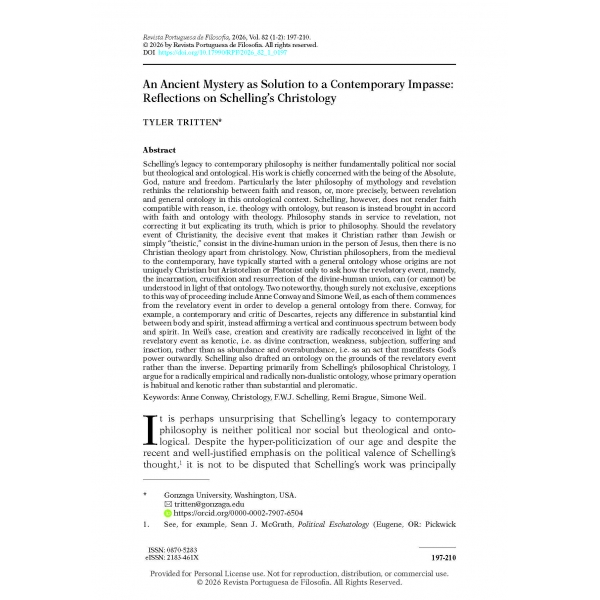
    Abstract Schelling’s legacy to contemporary philosophy is neither fundamentally political nor social but theological and ontological. His work is chiefly concerned with the being of the Absolute, God, nature and freedom. Particularly the later philosophy of mythology and revelation rethinks the relationship between faith and reason, or, more precisely, between revelation and general ontology in this ontological context. Schelling, however, does not render faith compatible with reason, i.e. theology with ontology, but reason is instead brought in accord with faith and ontology with theology. Philosophy stands in service to revelation, not correcting it but explicating its truth, which is prior to philosophy. Should the revelatory event of Christianity, the decisive event that makes it Christian rather than Jewish or simply “theistic,” consist in the divine-human union in the person of Jesus, then there is no Christian theology apart from christology. Now, Christian philosophers, from the medieval to the contemporary, have typically started with a general ontology whose origins are not uniquely Christian but Aristotelian or Platonist only to ask how the revelatory event, namely, the incarnation, crucifixion and resurrection of the divine-human union, can (or cannot) be understood in light of that ontology. Two noteworthy, though surely not exclusive, exceptions to this way of proceeding include Anne Conway and Simone Weil, as each of them commences from the revelatory event in order to develop a general ontology from there. Conway, for example, a contemporary and critic of Descartes, rejects any difference in substantial kind between body and spirit, instead affirming a vertical and continuous spectrum between body and spirit. In Weil’s case, creation and creativity are radically reconceived in light of the revelatory event as kenotic, i.e. as divine contraction, weakness, subjection, suffering and inaction, rather than as abundance and overabundance, i.e. as an act that manifests God’s power outwardly. Schelling also drafted an ontology on the grounds of the revelatory event rather than the inverse. Departing primarily from Schelling’s philosophical Christology, I argue for a radically empirical and radically non-dualistic ontology, whose primary operation is habitual and kenotic rather than substantial and pleromatic.
    Date 2026
    Language English
    Library Catalog 193; 113; 115; 126; 210
    License © 2026 by Aletheia - Associação Científica e Cultural
    Volume 82
    Place Braga
    Publisher Axioma - Publicações da Faculdade de Filosofia
    Section Schelling’s Legacy in Contemporary Philosophy. Celebrating the 250th Anniversary of Schelling’s Birth
    Pages 197-210
    Publication Revista Portuguesa de Filosofia
    DOI 10.17990/RPF/2026_82_1_0197
    Issue 1-2
    Journal Abbr RPF
    ISSN 0870-5283 ; 2183-461X
    Date Added 7/31/2026, 8:54:36 PM
    Modified 8/1/2026, 2:07:39 PM

    Tags:

    • Anne Conway
    • Christology
    • F.W.J. Schelling
    • Remi Brague
    • Simone Weil

    Notes:

    • Agamben, Giorgio. The Coming Community. University of Minnesota Press, 2007.

      Boutroux, Émile. The Contingency of the Laws of Nature. The Open Court Publishing Company, 1916.

      Brague, Rémi. On the God of the Christians (and one or two others). Translated by Sean Seaton. St. Augustine’s Press, 2013.

      Bruff, Kyla. “The State as Second Nature in Schelling’s System of Transcendental Idealism.” Studies in German Idealism 22 (2023): 177-196.

      Conway, Anne. The Principles of the Most Ancient and Modern Philosophy. Cambridge University Press, 1996

      Das, Saitya Brata. The Political Theology of Schelling. Edinburgh University Press, 2016.

      Gauchet, Marcel. The Disenchantment of the World. Translated by Oscar Burge. Princeton University Press, 1999.

      Heidegger, Martin. Identity and Difference. Translated by Joan Stambaugh. Harper & Row, 1969.

      Kierkegaard, Søren. “The Changelessness of God.” In The Essential Kierkegaard, edited by Howard V. Hong and Edna H. Hong. Princeton University Press, 1995.

      McGrath, Sean. J. Political Eschatology. Pickwick Publications, 2023.

      McGrath, Sean. J. “Spirit of Nature/Spirit of God: The Late Schelling’s Speculative Theology of the World Soul.” Science et Esprit 76, no. 3 (2024): 343-362

      Peirce, C.S. “A Guess at the Riddle.” In Essential Peirce, Vol 1: Selected Philosophical Writing, 1867-1893, edited by Peirce Edition Project. Indiana University Press, 1992.

      Peirce, C.S. “The Law of Mind.” In Essential Peirce, Vol 2: Selected Philosophical Writing, 1893-1913, edited by Peirce Edition Project. Indiana University Press, 1998.

      Scheerlinck, Ryan. “Philosophie und Religion”, Schellings Politische Philosophie. Verlag Karl Alber, 2017.

      Schelling, F.W.J. “Der Monotheismus.” In Sämtliche Werke: II/2, edited by K.F.A. Schelling. Cotta Verlag, 1856.

      Schelling, F.W.J. Urfassung der Philosophie der Offenbarung: Vols. I-II. Meiner Verlag, 1992.

      Tilliette, Xavier. La christologie idéaliste. Desclée,1995.

      Tilliette, Xavier. Le Christ de la philosophie: Prolégomènes à une christologie philosophique. Cerf, 1990.

      Tilliette, Xavier. Le Christ des philosophes: Du Maître de sagesse au divin témoin. Lessius,1993.

      Tilliette, Xavier. Philosophische Christologie: Eine Hinführung. Translated by Jörg Disse. Johannes Verlag, 1998.

      Tilliette, Xavier. Qu’est-ce que la christologie philosophique ? Parole Silence, 2013.

      Tritten, Tyler. “Christ as Copula: On the Incarnation and the Possibility of Religious Exclusivism,” Analecta Hermeneutica 6, (2014): 1-21.

      Weil, Simone. Gravity and Grace. Routledge, 2002.

Pesquisa

Carrinho  

Sem produtos

Envio 0,00 €
Total 0,00 €

Carrinho Encomendar

PayPal