Categories

Apostolado da Oração

Search

The Fronteira Palace – from War Time to the Triumph of Peace

The Fronteira Palace – from War Time to the Triumph of Peace

Jorge de Novaes Bastos, “The Fronteira Palace – from War Time to the Triumph of Peace,” in Educação e Cultura de Paz: Memória, Verdade e Perdão, 1st ed., ed. Carlos V. Estêvão et al., Axioma Series in Pedagogy and Philosophy of Education 5 (Braga: Axioma - Publicações da Faculdade de Filosofia, 2025), 267–82, https://doi.org/10.17990/AxiSeries/2025_05_267.

More details


0,00 € tax excl.

202505267


  • The Fronteira Palace – from War Time to the Triumph of Peace

    Item Type Book Section
    Editor Carlos V. Estêvão
    Editor José Manuel Martins Lopes
    Editor Ana Paula Pinto
    Editor Artur Ilharco Galvão
    Editor João Carlos Onofre Pinto
    Editor Maria José Lopes
    Editor Paulo C. Dias
    Editor Ricardo Barroso Batista
    Author Jorge de Novaes Bastos
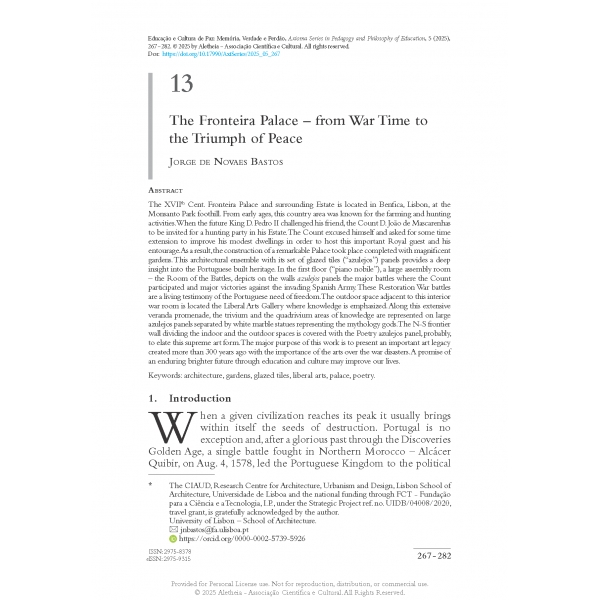
    Abstract The XVIIth Cent. Fronteira Palace and surrounding Estate is located in Benfica, Lisbon, at the Monsanto Park foothill. From early ages, this country area was known for the farming and hunting activities. When the future King D. Pedro II challenged his friend, the Count D. João de Mascarenhas to be invited for a hunting party in his Estate. The Count excused himself and asked for some time extension to improve his modest dwellings in order to host this important Royal guest and his entourage. As a result, the construction of a remarkable Palace took place completed with magnificent gardens. This architectural ensemble with its set of glazed tiles (“azulejos”) panels provides a deep insight into the Portuguese built heritage. In the first floor (“piano nobile”), a large assembly room – the Room of the Battles, depicts on the walls azulejos panels the major battles where the Count participated and major victories against the invading Spanish Army. These Restoration War battles are a living testimony of the Portuguese need of freedom. The outdoor space adjacent to this interior war room is located the Liberal Arts Gallery where knowledge is emphasized. Along this extensive veranda promenade, the trivium and the quadrivium areas of knowledge are represented on large azulejos panels separated by white marble statues representing the mythology gods. The N-S frontier wall dividing the indoor and the outdoor spaces is covered with the Poetry azulejos panel, probably, to elate this supreme art form. The major purpose of this work is to present an important art legacy created more than 300 years ago with the importance of the arts over the war disasters. A promise of an enduring brighter future through education and culture may improve our lives.
    Date 2025
    Language English
    Library Catalog
    URL https://doi.org/10.17990/AxiSeries/2025_05_267
    Rights © 2025 Aletheia - Associação Científica e Cultural
    Place Braga
    Publisher Axioma - Publicações da Faculdade de Filosofia
    ISBN 978-972-697-397-3 978-972-697-398-0
    Pages 267-282
    Series Axioma Series in Pedagogy and Philosophy of Education
    Series Number 5
    Edition 1
    Book Title Educação e Cultura de Paz: Memória, Verdade e Perdão
    Date Added 11/6/2025, 4:55:39 PM
    Modified 11/6/2025, 8:24:07 PM

    Tags:

    • architecture, gardens, glazed tiles, liberal arts, palace, poetry

    Notes:

    • Cassiano Neves, José, Jardim e Palácio dos Marqueses de Fronteira (in Portuguese), 2nd edition (Lisboa: Câmara Municipal de Lisboa, 1954).

      Flor, Susana Varela, “Portraits by Feliciano de Almeida (1635-1694) in Cosimo III de Medici Gallery”, Journal of the International Association of Research Institutes of the Art History RIHA Journal 0144, Dec. 01, 2016; http://www.riha-journal.org/articles/2016/0144-flor; https://doi.org/10.11588/riha.2016.0.70196.

      Ortega y Gasset, José, Meditaciones del Quijote, (in Spanish); edición facsimile de la primera edición de 1914; (Madrid: Alianza Editorial S.A., Fundación José Ortega y Gasset - Gregório Marañon, Fundación Residencia de Estudiantes, 2014).

      Pais, Amelia Pinto (org.) – Os Lusíadas por Luís de Camões, (in Portuguese), (high school edition), (Porto: Areal Edit., 2011).

      Willmann, Otto The Catholic Encyclopedia on-line, s.v. “The Seven Liberal Arts”, (New York:Robert Appleton Company,1907); accessed on Aug. 22, 2024, http://www.newadvent.org/cathen/01760a.htm

Cart  

No products

Shipping 0,00 €
Total 0,00 €

Cart Check out

PayPal

Search