Categories

Viewed products

Apostolado da Oração

Search

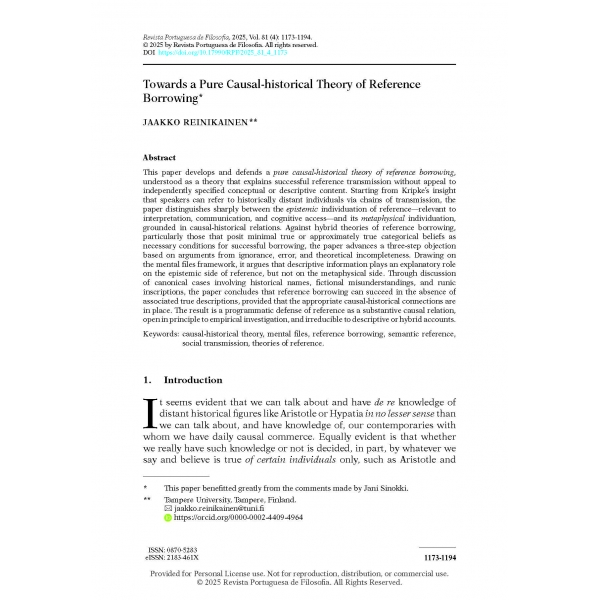
Towards a Pure Causal-Historical Theory of Reference Borrowing

Towards a Pure Causal-Historical Theory of Reference Borrowing

Jaakko Reinikainen, “Towards a Pure Causal-Historical Theory of Reference Borrowing,” Revista Portuguesa de Filosofia 81, no. 4 (2025): 1173–94, https://doi.org/10.17990/RPF/2025_81_4_1173.

More details

On sale On sale!
10,00 € tax excl.

128141173

Online only

  • Towards a Pure Causal-historical Theory of Reference Borrowing

    Item Type Journal Article
    Author Jaakko Reinikainen
    Abstract This paper develops and defends a pure causal-historical theory of reference borrowing, understood as a theory that explains successful reference transmission without appeal to independently specified conceptual or descriptive content. Starting from Kripke’s insight that speakers can refer to historically distant individuals via chains of transmission, the paper distinguishes sharply between the epistemic individuation of reference—relevant to interpretation, communication, and cognitive access—and its metaphysical individuation, grounded in causal-historical relations. Against hybrid theories of reference borrowing, particularly those that posit minimal true or approximately true categorical beliefs as necessary conditions for successful borrowing, the paper advances a three-step objection based on arguments from ignorance, error, and theoretical incompleteness. Drawing on the mental files framework, it argues that descriptive information plays an explanatory role on the epistemic side of reference, but not on the metaphysical side. Through discussion of canonical cases involving historical names, fictional misunderstandings, and runic inscriptions, the paper concludes that reference borrowing can succeed in the absence of associated true descriptions, provided that the appropriate causal-historical connections are in place. The result is a programmatic defense of reference as a substantive causal relation, open in principle to empirical investigation, and irreducible to descriptive or hybrid accounts.
    Date 2025
    Library Catalog 401; 401.43; 401.45; 160; 401.41
    License © 2026 by Aletheia - Associação Científica e Cultural
    Volume 81
    Publisher Axioma - Publicações da Faculdade de Filosofia
    Section Philosophy of Language: New Frontiers in Meaning and Use
    Pages 1173-1194
    Publication Revista Portuguesa de Filosofia
    DOI 10.17990/RPF/2025_81_4_1173
    Issue 4
    Journal Abbr RPF
    ISSN 0870-5283 ; 2183-461X
    Date Added 1/31/2026, 7:42:05 PM
    Modified 1/31/2026, 9:22:28 PM

    Tags:

    • causal-historical theory
    • mental files
    • reference borrowing
    • semantic reference
    • social transmission
    • theories of reference

    Notes:

    • Bianchi, Andrea. “Repetition and Reference.” In On Reference, edited by Andrea Bianchi, 93–106. Oxford: Oxford University Press, 2015. https://doi.org/10.1093/acprof:oso/9780198714088.003.0006.

      Brandom, Robert. Making It Explicit: Reasoning, Representing, and Discursive Commitment. Cambridge, MA: Harvard University Press, 1994.

      Devitt, Michael. Designation. New York: Columbia University Press, 1981. https://doi.org/10.7312/devi90836.

      Devitt, Michael. “Should Proper Names Still Seem So Problematic?” In On Reference, edited by Andrea Bianchi, 108–144. Oxford: Oxford University Press, 2015. https://doi.org/10.1093/acprof:oso/9780198714088.003.0007.

      Devitt, Michael. “Singular Terms.” Journal of Philosophy 71, no. 7 (1974): 183–205. https://doi.org/10.2307/2025347.

      Devitt, Michael, and Kim Sterelny. Language and Reality: An Introduction to the Philosophy of Language. 2nd ed. Cambridge, MA: MIT Press, 1999.

      Evans, Gareth. The Varieties of Reference. Edited by John McDowell. New York: Oxford University Press, 1982.

      Evans, Gareth, and J. E. J. Altham. “The Causal Theory of Names.” Proceedings of the Aristotelian Society, Supplementary Volumes 47 (1973): 187–225. https://doi.org/10.1515/9783110843828.361.

      Fernández Moreno, Luis. “Should a Causal Theory of Reference Borrowing Be a Descriptive-Causal Theory?” Organon F 25, no. 4 (2018): 473–494.

      Gómez-Torrente, Mario. Roads to Reference: An Essay on Reference Fixing in Natural Language. Oxford: Oxford University Press, 2019. https://doi.org/10.1093/oso/9780198846277.001.0001.

      Grice, H. P. “Meaning.” The Philosophical Review 66, no. 3 (1957): 377–388. https://doi.org/10.2307/2182440.

      Jutronić, Dunja. “Reference Borrowing and the Role of Descriptions.” Croatian Journal of Philosophy 8, no. 24 (2008).

      Kripke, Saul A. Naming and Necessity. Cambridge, MA: Harvard University Press, 1980.

      Kripke, Saul A. “A Problem in the Theory of Reference: The Linguistic Division of Labor and the Social Character of Naming.” In Philosophy and Culture: Proceedings of the XVIIth World Congress of Philosophy, 241–247. Montreal: Éditions du Beffroi and Éditions Montmorency, 1986.

      Kripke, Saul A. “Speaker’s Reference and Semantic Reference.” Midwest Studies in Philosophy 2 (1977): 255–276. https://doi.org/10.1111/j.1475-4975.1977.tb00045.x.

      Raatikainen, Panu. “Theories of Reference: What Was the Question?” In Language and Reality from a Naturalistic Perspective: Themes from Michael Devitt, edited by Andrea Bianchi, 69–103. Cham: Springer, 2020. https://doi.org/10.1007/978-3-030-47641-0.

      Recanati, François. Mental Files. Oxford: Oxford University Press, 2012. https://doi.org/10.1093/acprof:oso/9780199659982.001.0001.

      Sainsbury, R. M. “Reference and Anaphora.” Philosophical Perspectives 16 (2002): 43–71. https://doi.org/10.1111/1468-0068.36.s16.3.

      Strawson, P. F. Individuals: An Essay in Descriptive Metaphysics. London: Routledge, 1990.

      Svärdström, Elisabeth. “Runorna i Hagia Sofia.” Fornvännen 65 (1970): 247–249.

Cart  

No products

Shipping 0,00 €
Total 0,00 €

Cart Check out

PayPal

Search