Everything You Think about Equivocation Is False
Bryan Frances, “Everything You Think about Equivocation Is False,” Revista Portuguesa de Filosofia 81, no. 4 (2025): 1251–72, https://doi.org/10.17990/RPF/2025_81_4_1251.


António M. Costa, “Modernidade e...

Bryan Frances, “Everything You Think about Equivocation Is False,” Revista Portuguesa de Filosofia 81, no. 4 (2025): 1251–72, https://doi.org/10.17990/RPF/2025_81_4_1251.
| Item Type | Journal Article |
|---|---|
| Author | Bryan Frances |
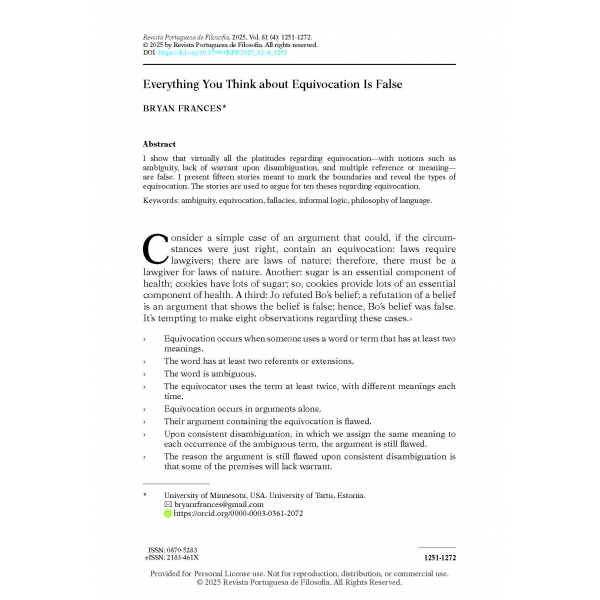
| Abstract | I show that virtually all the platitudes regarding equivocation—with notions such as ambiguity, lack of warrant upon disambiguation, and multiple reference or meaning—are false. I present fifteen stories meant to mark the boundaries and reveal the types of equivocation. The stories are used to argue for ten theses regarding equivocation. |
| Date | 2025 |
| Library Catalog | 401; 401.43; 401.45; 160; 401.41 |
| License | © 2026 by Aletheia - Associação Científica e Cultural |
| Volume | 81 |
| Publisher | Axioma - Publicações da Faculdade de Filosofia |
| Section | Philosophy of Language: New Frontiers in Meaning and Use |
| Pages | 1251-1272 |
| Publication | Revista Portuguesa de Filosofia |
| DOI | 10.17990/RPF/2025_81_4_1251 |
| Issue | 4 |
| Journal Abbr | RPF |
| ISSN | 0870-5283 ; 2183-461X |
| Date Added | 1/31/2026, 7:42:09 PM |
| Modified | 1/31/2026, 9:22:37 PM |
Burge, Tyler. “Individualism and the Mental.” In Midwest Studies in Philosophy: Studies in Metaphysics, edited by P. French, T. Uehling, Jr., and H. Wettstein, 73-122. Minneapolis: University of Minnesota Press, 1979. https://doi.org/10.1111/j.1475-4975.1979.tb00374.x
Burge, Tyler. “Other Bodies.” In Thought and Object, edited by A. Woodfield, 97-120. New York: Oxford University Press, 1982.
Chalmers, David. “The Nature of Narrow Content.” Philosophical Issues 13 (2003): 46–66. https://doi.org/10.1111/1533-6077.00004
Dowden, Bradley. “Fallacies.” The Internet Encyclopedia of Philosophy, accessed February 2023.
Gerken, Mikkel. “Conceptual Equivocation and Warrant by Reasoning.” Australasian Journal of Philosophy 89 (2011): 381-400. 10.1080/00048402.2010.488267
Gerken, Mikkel. “Conceptual Equivocation and Epistemic Relevance.” Dialectica 63 (2009): 117-32. https://doi.org/10.1111/j.1746-8361.2008.01169.x
Hansen, Hans. “Fallacies.” The Stanford Encyclopedia of Philosophy (Summer 2020 Edition), edited by Edward N. Zalta, 2020.
Jackson, Frank. “Narrow Content and Representation, or Twin Earth Revisited.” Proceedings and Addresses of the American Philosophical Association 77 (2003): 55–70. https://doi.org/10.2307/3219741
Kaplan, David. “Words.” Aristotelian Society Supplementary Volume 64 (1990): 93-119. 10.1093/aristoteliansupp/64.1.93
Kriegel, Uriah. “Real Narrow Content.” Mind and Language 23 (2008): 305–28. 10.1111/j.1468-0017.2008.00345.x
Kripke, Saul. “A Puzzle about Belief.” In Meaning and Use, edited by A. Margalit. 239-83. Dordrecht: D. Reidel, 239-83. Reprinted in Propositions and Attitudes, edited by N. Salmon and S. Soames, 102-48. New York: Oxford University Press, 1988. https://doi.org/10.1007/978-1-4020-4104-4_20
Kripke, Saul. Naming and Necessity. Cambridge: Harvard University Press, 1980.
Loar, Brian. “Social Content and Psychological Content.” In Contents of Thought, edited by R. Grimm and D. Merrill. Tucson: University of Arizona Press, 1988. https://doi.org/10.1093/acprof:oso/9780199673353.003.0010
Stoneham, Tom. “On Equivocation.” Philosophy 78, no. 4 (2003): 515-19. 10.1017/s0031819103000469
Yli-Vakkuri, Juhani, and John Hawthorne. Narrow Content. Oxford: Oxford University Press, 2018. https://doi.org/10.1093/oso/9780198785965.001.0001