Categorias

Apostolado da Oração

Pesquisa

Visões do coletivo e da partilha em Homero e Aquilino: entre a convergência e a diferença

Visões do coletivo e da partilha em Homero e Aquilino: entre a convergência e a diferença

Maria José Ferreira Lopes, «Visões do coletivo e da partilha em Homero e Aquilino: entre a convergência e a diferença», Revista Portuguesa de Humanidades 26, n.o 1–2 (2022): 105–24, https://doi.org/10.17990/RPH/2022_26_1_105.

Mais detalhes

À venda À venda!
10,00 €

222610105

Disponível apenas on-line


  • Visões do coletivo e da partilha em Homero e Aquilino: entre a convergência e a diferença

    Tipo Artigo em Revista Científica
    Autor Maria José Ferreira Lopes
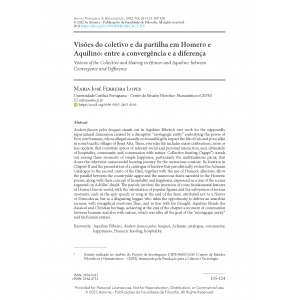
    Resumo Andam faunos pelos bosques stands out in Aquilino Ribeiro’s vast work for the supposedly supernatural dimension created by a disruptive “mystagogic entity” embodying the power of Eros over humans, whose alleged assaults on beautiful girls impact the life of rich and poor alike in some bucolic villages of Beira Alta. There, everyday life includes many celebrations, more or less opulent, that constitute spaces of relevant social and personal interaction, and, ultimately, of hospitality, community and communion with nature. Collective feasting (“agape”) stands out among these moments of simple happiness, particularly the multitudinous picnic that closes the otherwise unsuccessful hunting journey for the mysterious creature. Its location in Chapter II and the presentation of a catalogue of hunters that parodistically evokes the Achaean Catalogue in the second canto of the Iliad, together with the use of Homeric allusions, allow the parallel between the countryside agape and the numerous feasts narrated in the Homeric poems, along with their concept of hospitality and happiness, expressed in some of the scenes engraved on Achilles’ shield. The parody involves the inversion of some fundamental features of Homer’s heroic world, with the valorisation of popular figures and the subversion of serious moments, such as the epic speech or song at the end of the feast, attributed not to a Nestor or Demodocus, but to a disgusting beggar, who takes the opportunity to deliver an anarchist sermon, with evangelical overtones.Thus, and in line with his thought, Aquilino blends the classical and Christian heritage, achieving at the end of the chapter a moment of communion between humans and also with nature, which was after all the goal of the “mystagogic entity” and his human avatars.
    Data 2022
    Língua Portuguese
    Direitos © 2022 Aletheia - Associação Científica e Cultural
    Extra Visions of the Collective and Sharing in Homer and Aquilino: between Convergence and Difference
    Volume 26
    Páginas 105-124
    Publicação Revista Portuguesa de Humanidades
    DOI 10.17990/RPH/2022_26_1_105
    Número 1-2
    ISSN 0874-0321
    Data de Adição 30/12/2022, 01:26:01
    Modificado 30/12/2022, 02:27:46

    Etiquetas:

    • Aquilino Ribeiro, Andam faunos pelos bosques, Achaean catalogue, community, happinness, Homeric feasting, hospitality

    Notas:

    • Barker, Elton. “Institucionalising dissent in Homer’s Illiad. Proceedings of the Cambridge Philological Society, No. 50, Cambridge: Cambridge University Press, 2004, 92-120.

      Hardie, R. “Imago Mundi: Cosmological and Ideological Aspects of the Shield of Achilles.” The Journal of Hellenic Studies Vol. 105 (1985), 11-31.

      Homero, Ilíada, tradução de Frederico Lourenço. Lisboa: Cotovia, 2005.

      Homero, Odisseia, tradução de Frederico Lourenço. Lisboa: Cotovia, 2003.

      Kirk, G. S., The Iliad: a commentary, 6 vol. Cambridge: Cambridge University Press, 1993-2000.

      Lage, Rui. “O Demo na Arcádia: natureza, artifício e alegoria em Andam Faunos pelos Bosques.” In Nos passos de Aquilino, editado por Mª João Renaud, Francisco Topa & John Greenfield. Frankfurt am Main: Peter Lang, 2016, 225-232.

      Lourenço, Eduardo (1987). “Aquilino, ou Eros e Cristo.” Colóquio|Letras (nº 100, Novembro-Dezembro 1987), 60-69.

      Martindale, Charles. Redeeming the Text: Latin Poetry and the Hermeneutics of Reception. Cambridge: Cambridge University Press. 1993.

      Mourão-Ferreira, David. “Notas sobre a «continentalidade» de Aquilino.” In David Mourão-Ferreira, Sob o mesmo tecto. Estudos sobre Autores de Língua Portuguesa. Lisboa: Editorial Presença, 1989, 123-132.

      Pereira, Elsa. “Itinerário de uma reescrita: Filhas de Babilónia e Andam Faunos pelos Bosques, de Aquilino Ribeiro.” In Nos passos de Aquilino, editado por Mª João Renaud, Francisco Topa & John Greenfield. Frankfurt am Main: Peter Lang, 2016, 181-224.

      Pereira, José Carlos Seabra. “A poética vitalista em Aquilino.” In José Carlos Seabra Pereira, Aquilino – a escrita vital. S/L: Babel, 2014, 17-106.

      Pereira, Paulo Alexandre. “Aquilino e os Faunos”. In Aquilino Ribeiro, coordenado por António M. Ferreira e Paulo Neto. Aveiro: Ed. Universidade de Aveiro, 2009, 7-30.

      Ribeiro, Aquilino, Andam Faunos pelos Bosques. Lisboa: Círculo de Leitores, 1983.

      Sherratt, Susan. “Feasting in Homeric Epic.” Hesperia: The Journal of the American School of Classical Studies at Athens Special Issue: The Mycenean Feast (Vol. 73, No. 2Apr. – Jun., 2004), 301-337.

      Schopenhauer, Arthur. Metafísica do amor, metafísica da morte, tradução de Jair Barbosa, versão técnica de M. Lúcia M. O. Cacciola. São Paulo, Brasil: Martins Fontes, 2000.

      Sousa, Martim de Gouveia. “Ensaio sobre a influência e a ascensão em Andam faunos pelos bosques & não só: Aquilino Ribeiro e Francisco Moura Seco.” Cadernos Aquilinianos (22, 2014), pp. 71-81.

      Wright, James C. “A Survey of Evidence for Feasting in Mycenaean Society.” Hesperia: The Journal of the American School of Classical Studies at Athens, Special Issue: The Mycenean Feast Vol. 73, No. 2, (Apr. – Jun., 2004), 133-178.

Pesquisa

Carrinho  

Sem produtos

Envio 0,00 €
Total 0,00 €

Carrinho Encomendar

PayPal