Musical Minimalism and the Metaphysics of Time
Nemesio García-Carril Puy, “Musical Minimalism and the Metaphysics of Time,” Revista Portuguesa de Filosofia 74, no. 4 (2018): 1267–1306, https://doi.org/10.17990/RPF/2018_74_4_1267.


James O. Young, “Empiricism and the...

Nemesio García-Carril Puy, “Musical Minimalism and the Metaphysics of Time,” Revista Portuguesa de Filosofia 74, no. 4 (2018): 1267–1306, https://doi.org/10.17990/RPF/2018_74_4_1267.
| Type | Journal Article |
|---|---|
| Author | Nemesio García-Carril Puy |
| Rights | © 2018 Aletheia - Associação Científica e Cultural | © 2018 Revista Portuguesa de Filosofia |
| Volume | 74 |
| Issue | 4 |
| Pages | 1267-1306 |
| Publication | Revista Portuguesa de Filosofia |
| ISSN | 0870-5283 |
| Date | 2018 |
| DOI | 10.17990/RPF/2018_74_4_1267 |
| Language | English |
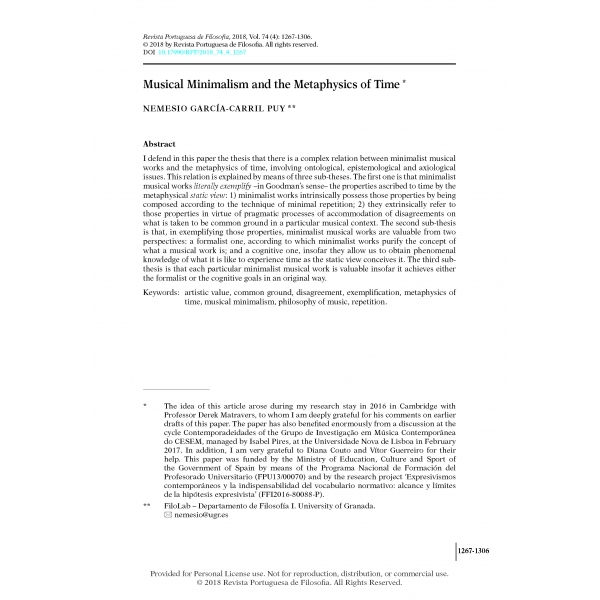
| Abstract | I defend in this paper the thesis that there is a complex relation between minimalist musical works and the metaphysics of time, involving ontological, epistemological and axiological issues. This relation is explained by means of three sub-theses. The first one is that minimalist musical works literally exemplify –in Goodman’s sense– the properties ascribed to time by the metaphysical static view: 1) minimalist works intrinsically possess those properties by being composed according to the technique of minimal repetition; 2) they extrinsically refer to those properties in virtue of pragmatic processes of accommodation of disagreements on what is taken to be common ground in a particular musical context. The second sub-thesis is that, in exemplifying those properties, minimalist musical works are valuable from two perspectives: a formalist one, according to which minimalist works purify the concept of what a musical work is; and a cognitive one, insofar they allow us to obtain phenomenal knowledge of what it is like to experience time as the static view conceives it. The third sub-thesis is that each particular minimalist musical work is valuable insofar it achieves either the formalist or the cognitive goals in an original way. |
| Date Added | 23/01/2019, 18:45:26 |
| Modified | 24/01/2019, 11:02:38 |
Auner, Joseph. Music in the Twentieth and Twenty-First Centuries. Western Music in Context: A Norton History. New York: W. W. Norton & Company, 2013.
Aristotle, “Sobre los pitagóricos”. In Aristóteles. Fragmentos, Introduction, translation and notes by Álvaro Vallejo Campos, 435-459. Madrid: Gredos, 2005. doi: 10.1163/24680974-90000505.
Boltzmann, Ludwig. Lectures on Gas Theory, Translation by Stephen G. Brush. Berkeley: University of California Press, 1896–1898 /1964. doi: 10.1063/1.3051862.
Budd, Malcolm. “The intersubjective validity of aesthetic judgments”. British Journal of Aesthetics, Vol. 47, No. 4 (2007): 333-371. doi.org/10.1093/aesthj/aym021
Casati, Roberto, and Varzi Archille. “Events”. In The Stanford Encyclopedia or Philosophy, edited by Edward N. Zalta (2015). doi: 10.1093/acprof:oso/9780195188370.001.0001
Danto, Arthur. The Transfiguration of the Commonplace. Cambridge, MA: Harvard University Press, 1981. doi:10.2307/430413.
Davies, David. Art as performance. Oxford: Blackwell Publishing, 2004. doi: 10.1002/9780470774922.
Davies, David. The philosophy of the performing arts. West Sussex: Willey-Blackwell. 2011. doi: 10.1002/9781444343458.
Davies, David. “Medium”. In The Routledge Companion to Philosophy and Music. Edited by Theodore Gracyk and Andrew Kania, 48-58. Oxon: Routledge, 2011.
Davies, David. “Categories of art”. In The Routledge Companion to Aesthetics, edited by Berys Gaut and Dominic Lopes, 224-234. New York: Routledge, 2013. doi.org/10.4324/9780203390795.
Deliege, Célestin. Cinquante ans de modernité musicale: de Darmstadt à l’IRCAM. Sprimont (Belgique): Pierre Mardaga Éditeur, 2003.
Descartes, René. Compendio de música. Introduction, translation and notes by Ángel Gabilondo. Madrid: Tecnos, 1992.
Dibelius, Ulrich. La música contemporánea a partir de 1945. Translated by Isabel García Adánez. Madrid: Akal, 1998/2004.
Dodd, Julian. Works of music. An essay in ontology. Oxford: Oxford University Press, 2007.
Dodd, Julian. “Defending the discovery model in the ontology of art: a reply to Amie Thomasson on the qua problem”. British Journal of Aesthetics 52, no. 1 (2012): 75-95. doi: 10.1093/aesthj/ayr047.
Dodd, Julian. “Adventures in the metaontology of art: local descriptivism, artefacts and dreamcatchers”. Philosophical Studies, no. 165 (2013): 1047-1068. doi: 10.1007/s11098-012-9999-z.
Fink, Robert. Repeating Ourselves: American Minimal Music as Cultural Practice. Berkeley, CA: University of California Press, 2005.
Fink, Robert. “(Post-)minimalisms 1970–2000: the search for a new mainstream”. In The Cambridge History of Twentieth Century Music, edited by Nicholas Cook and Anthony Pople, 539–556. Cambridge: Cambridge University Press, 2004.
Fried, M. Art and Objecthood. Essays and Reviews. Chicago: The University of Chicago Press, 1998.
Gann, Keith. Potter, Kyle. & Siôn, Pwill. The Ashgate Research companion to minimalist and postminimalist music. Surrey: Ashgate, 2013. doi.org/10.1017/S0040298214000552.
Gedalge, André. Trattato della Fuga. Milano: Edizioni Curci, 1952.
Goodman, Nelson. Languages of Art. An approach to a theory of symbols. Indianápolis: The Hobbs-Merrill Company, 1976.
Goodman, Nelson. Ways of Worldmaking. Indianápolis: Hacket Publishing Company, 1978.
Greenberg, Clement. “Abstracto y representacional”. In Arte y cultura. Edited by Clement Greenberg, 155-160. Barcelona: Gustavo Gili, 1979.
Griffiths, Paul. Modern Music and After. New York: Oxford University Press, 2010 [3rd ed.].
Kania, Andrew. “The methodology of musical ontology: descriptivism and its implications”. British Journal of Aesthetics 48, no. 4 (2008): 426-444. doi.org/10.1093/aesthj/ayn034.
Lewis, David K. “Causation”. In Philosophical Papers, Volume II, edited by David Lewis, 159-213. New York: Oxford University Press, 1986.
Lewis, David. K. “Counterfactual dependence and time’s arrow”. In Philosophical Papers, Volume II, edited by David Lewis, 32-51. New York: Oxford University Press, 1986.
Lewis, David K. “What experience teaches”. In Papers in Metaphysics and Epistemology, edited by David Lewis, 286-8. Cambridge: Cambridge University Press, 1999.
Matravers, Derek. “Art, expression and emotion”. In The Routledge Companion to Aesthetics, edited by Berys Gaut and Dominic Lopes, 404-414. New York: Routledge, 2013. doi.org/10.4324/9780203390795.
Mellor, David. H. “The direction of time”. In The Routledge Companion to Metaphysics, edited by Robin Le Poidevin, Peter Simons, Andrew McGonigal, Ross P. Cameron, 449-458. London: Routledge, 2009. doi.org/10.4324/9780203879306.ch42.
Mertens, Wim. American minimal music. La Monte Young, Terry Riley, Steve Reich, Phillip Glass. London: Kahn & Averil, 1983. doi.org/10.2307/3051553.
Morgan, Robert P. La música del siglo XX. Translated by Patricia Sojo. Madrid: Akal, 1991/1999.
Mozersky, Joshua. “Presentism”. In The Oxford Handbook of the Philosophy of Time, edited by Craig Callender, 122-144. New York: Oxford University Press, 2011. doi.org/10.1093/oxfordhb/9780199298204.003.0006
Olson, Eric T. “The passage of time” In The Routledge Companion to Metaphysics, edited by Robin Le Poidevin, Peter Simons, Andrew McGonigal, Ross P. Cameron, 440-448. London: Routledge, 2009. doi.org/10.4324/9780203879306.ch41.
Pérez Carreño, Francisca. Arte Minimal: Objeto y Sentido. Madrid: Antonio Machado Libros, 2002.
Price, Huw. “The flow of time”. In The Oxford Handbook of the Philosophy of Time, edited by Craig Callender, 276-311. New York: Oxford University Press, 2011. doi.org/10.1093/oxfordhb/9780199298204.003.0010.
Reinhardt, Ad. Art-as-Art. The Selected Writings of Ad Reinhardt. Edited by Barbara Rose. Berkeley and Los Angeles: University of California Press, 1991.
Sibely, Frank. “Aesthetics concepts”. The philosophical review, Vol. 74, No. 2 (1959): 135-159. doi.org/10.2307/2182490.
Stalnaker, Robert. Context. Oxford: Oxford University Press, 2014. doi.org/10.1093/acprof:oso/9780199645169.001.0001.
Strawson, Peter. Individuals: An Essay in Descriptive Metaphysics, London: Methue, 1959. doi.org/10.4324/9780203221303.
Taruskin, Richard. Music in the Late Twentieth-Century. The Oxford History of Western Music. 5. Oxford: Oxford University Press, 2010. 9780195384857.008.
Textor, Mark. “Samples as Symbols”. Ratio, XXI, 3, September (2008): 344-359. doi.org/10.1111/j.1467-9329.2008.00406.x
Thomasson, Amie. “Ontological Innovation in Art”. The Journal of Aesthetics and Art Criticism 68, 2 (2010): 119-130. doi.org/10.1111/j.1540-6245.2010.01397.x
Tymoczko, Dmitri. A geometry of music. Harmony and counterpoint in the extended common practice. New York: Oxford University Press, 2011.
Vega Rodríguez, Margarita, e Villar-Taboada, Carlos (eds.), El tiempo en las músicas del siglo XX. Valladolid: Universidad de Valladolid – SITEM, 2001.
Warburton, Dan. “A Working Terminology for Minimal Music”. Intégral, 2 (1988): 135–159.
Wollheim, Richard. On art and the mind. Cambridge, MA: Harvard University Press, 1974.


![Contributos dos ensino e da investigação, Nº [17-18] - Junho/Dezembro 2012](https://www.publicacoesfacfil.pt/img/p/530-576-medium.jpg "Contributos dos ensino e da investigação, Nº [17-18] - Junho/Dezembro 2012")