Philosophy and Science as Conversation
Tuchańska, Barbara. “Philosophy and Science as Conversation.” Revista Portuguesa de Filosofia 68, no. 1–2 (2012): 105–26. DOI 10.17990/RPF/2012_68_1_0105.


Panão, Miguel R. Oliveira. “Acaso...

Carvalho, José Maurício de, and Maria...

Tuchańska, Barbara. “Philosophy and Science as Conversation.” Revista Portuguesa de Filosofia 68, no. 1–2 (2012): 105–26. DOI 10.17990/RPF/2012_68_1_0105.
| Author | Barbara Tuchańska |
|---|---|
| Rights | © 2015 Aletheia - Associação Científica e Cultural | © 2015 Revista Portuguesa de Filosofia |
| Volume | 68 |
| Issue | 1-2 |
| Pages | 105-126 |
| Publication | Revista Portuguesa de Filosofia |
| ISSN | 0870-5283; 2183-461X |
| Date | 2012 |
| DOI | 10.17990/RPF/2012_68_1_0105 |
| Language | English |
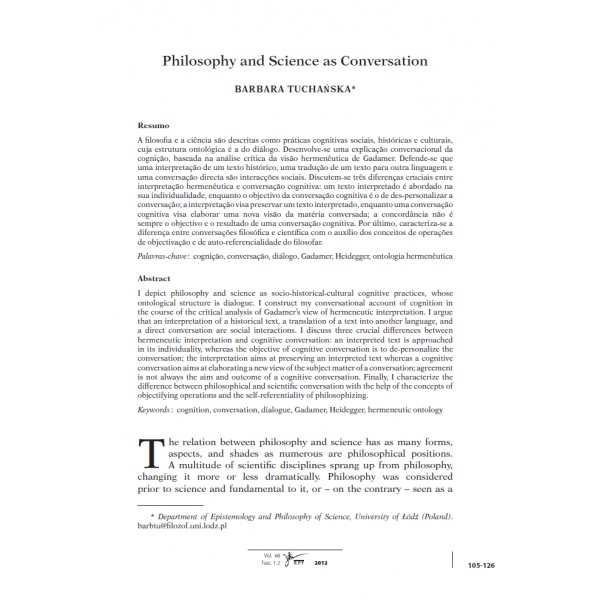
| Abstract | Resumo A filosofia e a ciência são descritas como práticas cognitivas sociais, históricas e culturais, cuja estrutura ontológica é a do diálogo. Desenvolve-se uma explicação conversacional da cognição, baseada na análise crítica da visão hermenêutica de Gadamer. Defende-se que uma interpretação de um texto histórico, uma tradução de um texto para outra linguagem e uma conversação directa são interacções sociais. Discutem-se três diferenças cruciais entre interpretação hermenêutica e conversação cognitiva: um texto interpretado é abordado na sua individualidade, enquanto o objectivo da conversação cognitiva é o de des-personalizar a conversação; a interpretação visa preservar um texto interpretado, enquanto uma conversação cognitiva visa elaborar uma nova visão da matéria conversada; a concordância não é sempre o objectivo e o resultado de uma conversação cognitiva. Por último, caracteriza-se a diferença entre conversações filosófica e científica com o auxílio dos conceitos de operações de objectivação e de auto-referencialidade do filosofar. Palavras-chave : cognição, conversação, diálogo, Gadamer, Heidegger, ontologia hermenêutica Abstract I depict philosophy and science as socio-historical-cultural cognitive practices, whose ontological structure is dialogue. I construct my conversational account of cognition in the course of the critical analysis of Gadamer’s view of hermeneutic interpretation. I argue that an interpretation of a historical text, a translation of a text into another language, and a direct conversation are social interactions. I discuss three crucial differences between hermeneutic interpretation and cognitive conversation: an interpreted text is approached in its individuality, whereas the objective of cognitive conversation is to de-personalize the conversation; the interpretation aims at preserving an interpreted text whereas a cognitive conversation aims at elaborating a new view of the subject matter of a conversation; agreement is not always the aim and outcome of a cognitive conversation. Finally, I characterize the difference between philosophical and scientific conversation with the help of the concepts of objectifying operations and the self-referentiality of philosophizing. Keywords : cognition, conversation, dialogue, Gadamer, Heidegger, hermeneutic ontology |
| Date Added | 02/07/2015, 17:20:41 |
| Modified | 13/07/2015, 10:01:23 |